
There is a moment when back pain stops sounding like back pain. The ache moves. It runs into a buttock, down a thigh, past the knee. It brings company: pins and needles in the foot, a burning stripe along the calf, a leg that feels vaguely unreliable on stairs. That is a different conversation from a sore back, and it deserves a different plan.
Spinal decompression is the non-surgical option most people find when they start searching that pattern. The idea is straightforward: lower the pressure across an irritated segment, give the nerve a little more room, and use that window to rebuild tolerance. Whether it belongs in your plan depends on what your exam shows, which is the part worth understanding before you book computer-guided traction on a decompression table anywhere.
How Do You Know Disc Pressure Is Driving Your Symptoms?
Three features raise the suspicion together: pain that travels into a limb rather than staying local, symptoms that change sharply with position, and sensory changes such as tingling, numbness or burning. One of those on its own means little. All three in the same story means something.
Mayo Clinic describes a herniated disk as the softer inner material pushing through the tougher outer ring, where it can press on a nerve and produce pain, numbness or weakness along that nerve's path. That anatomical picture is why the symptom map matters so much: the location of your numbness says more about which level is involved than the location of your ache does.
Position is the other tell. Long sitting, driving and forward bending load a lumbar disc, so symptoms that spike during a commute and ease after a walk fit the pattern. Symptoms that are identical no matter what you do usually do not.
What Does Non-Surgical Spinal Decompression Actually Do?
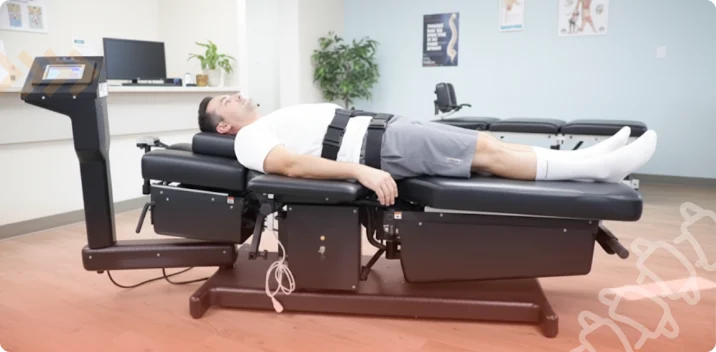
A decompression table applies controlled, cyclical traction along the length of the spine. The intent is to reduce compressive load across the targeted segment for a defined period, creating a short window where the pressure environment around the disc and nerve root is different from the one your day creates.
The most useful evidence comes from a randomized study in subacute lumbar disc herniation, where non-surgical decompression produced greater leg pain reduction and measurable shrinkage of herniated disc volume on follow-up imaging than the control condition. That is a real finding on a real outcome, and it is also one study in a selected population, which is how it should be read.
There is a second effect that gets less attention. When a segment stops feeling threatened, the muscles bracing around it often stop working so hard. Less guarding means smoother movement, and smoother movement is what lets rehabilitation begin.
Which Symptoms Suggest a Good Match, and Which Do Not?
Decompression is usually considered when the presentation looks like a bulging or herniated disc pressing on a nerve root: limb-travelling pain, position-dependent symptoms, sensory changes, and a story that has not settled with time and simple measures.
It is a poorer match when the picture points elsewhere. Pain that is purely local and mechanical, joint-driven pain with no neurological signs, and symptoms that behave identically in every position all suggest a different driver. So does a history dominated by severe instability, significant osteoporosis, prior fusion hardware or an active fracture, each of which needs its own conversation first.
Most disc herniations improve without surgery. StatPearls notes that the prognosis for lumbar disc herniation is generally favourable with conservative management, with many patients improving over weeks. That is reassuring, and it is also the reason to be picky: conservative care has room to work, so it is worth aiming it correctly.
Red Flags That Mean You Skip the Table and Call a Doctor
Some symptoms are not candidates for any conservative plan. Loss of bowel or bladder control, numbness across the saddle region, rapidly progressing weakness in a leg, significant trauma, fever alongside severe spine pain, or unexplained weight loss with new back pain all belong in an urgent medical evaluation the same day.
Those are the recognised warning signs in clinical practice. StatPearls lists saddle anesthesia, new bladder dysfunction and progressive neurological deficit among the red flags that change the pathway entirely.
Nobody at a chiropractic office should be talking you into a course of care when your story contains one of those. We screen for them at intake for exactly this reason, and a same-day referral is the right outcome when one appears.
What the First Stretch of a Decompression Plan Looks Like
The plan starts with the exam findings, not with the table. Range of motion, the positions that reproduce your symptoms, a neurological screen covering strength, reflexes and sensation, and an honest look at what your day actually demands of your spine.
From there, table settings are chosen for your presentation and your tolerance, and adjusted based on how you respond between visits. Progress gets tracked by things you can verify: how far the symptom travels down the leg, how long you can sit before it changes, whether you sleep through the night. Those markers are more informative than a pain score on its own.
The table is rarely the whole plan. It usually runs alongside the disc and nerve rehabilitation programs that support it, because pressure relief buys a window and movement work is what turns that window into durable tolerance.
Does Decompression Work Better Than Waiting It Out?
For some people, no. Many disc-related symptoms settle with time, sensible movement and patience, and someone in that group would improve either way. Honest care means saying so rather than selling a course to a body that was already on its way.
The group that benefits most is the one that has already waited. Months of symptoms, a clear nerve pattern, function that has narrowed, and no sign of the natural curve bending in the right direction. In that situation, structured pressure relief plus graded rehabilitation is a reasonable non-surgical option before anyone starts discussing injections or surgery.
If a course of care produces nothing measurable, that is information too. A plan that is not working should change rather than repeat, and saying so out loud is part of the job.
There is one more reason not to simply wait. Symptoms that have been running for months tend to reshape behaviour: you stop lifting, you stop walking as far, you sit differently, you sleep worse. Those changes outlast the original irritation and become their own problem. Treating the disc while also rebuilding the activity you dropped is what stops a nerve episode from turning into a permanently smaller week.
Getting a Straight Answer About Your Own Disc
Nerve-pattern symptoms make people cautious about ordinary things: sitting through a film, bending to load the dishwasher, driving to Lady Lake and back. That caution is rational, and it also shrinks your world one habit at a time.
A useful plan starts by confirming what is actually driving the pattern, then choosing tools that match it and measuring whether they are working. Dr. Justin Bergin, DC, will tell you when decompression fits your presentation and when it does not, which is the only version of this conversation worth having. Bring your symptom map and your timeline, and ask whether decompression suits your presentation at the Lakeland or Lady Lake office.
Ready to take the next step?
Talk with the ChiroMed team about a spinal decompression plan built around what your examination actually finds.