
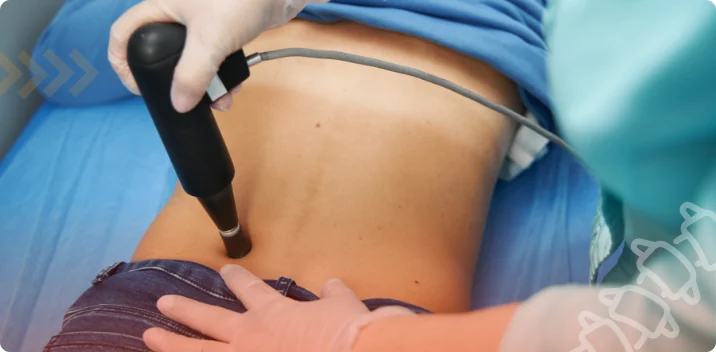
Pain that has lasted months stops behaving like a fresh injury. The tissue is quieter than it was at the start, yet it still complains on the stairs, still tightens after a long drive, still flares the moment you go back to the activity you want back. Shockwave therapy, known in the research literature as extracorporeal shockwave therapy or ESWT, comes up constantly in that situation, usually with no explanation of what the waves are doing once they reach tissue.
Here is the honest version. Acoustic pressure waves are a mechanical input. They do not numb the area, they do not deliver a drug, and they do not add anything to the body. What they add is a signal. Whether that signal helps you depends on what kind of problem you actually have, which is worth understanding before you sit down with Dr. Justin Bergin, DC, for acoustic wave treatment on the Omniwave system.
What Do Acoustic Waves Actually Do Inside Tissue?
A shockwave device sends short, high-energy acoustic pulses through the skin into the tissue underneath. Those pulses create rapid pressure changes that cells can detect. The cell then converts that mechanical event into a biological one, which is the reason the treatment is described as a stimulus rather than as a painkiller.
That conversion has a name. Mechanotransduction is the process of turning a mechanical push into a chemical signal inside the cell, and the tendon literature describes shockwave energy acting on endothelial cells to switch on the pathways tied to new blood vessel growth. More local circulation means more oxygen and more raw material arriving at a site that had been running lean.
Two things follow from that. The first is that shockwave therapy is dose dependent, because a signal that is too weak does nothing and a signal that is too strong is simply uncomfortable. The second is that the response belongs to your body. Nothing in the device heals the tendon. The device only asks.
Why Does Chronic Tendon Pain Stall Instead of Healing?
Healing runs in phases, and tissue can get stuck partway through. The repair response quiets down before the collagen has been fully reorganised, leaving a structure that is disordered and that tolerates less load than it used to. Pain then starts arriving at lower and lower thresholds during ordinary days.
Tendons are especially prone to this. They adapt to load slowly, they have a thinner blood supply than muscle, and they sit at the junction where force concentrates. Mayo Clinic notes that repeated motion from work or sport is the most common driver of tendon irritation, and repetition is exactly what most people cannot stop doing.
The frustrating part is the shape of the curve. Rest lowers symptoms, return to activity raises them, and the baseline never really moves. That plateau is the clinical signature of a tissue-tolerance problem rather than an ongoing injury.
Mechanotransduction, in Plain Language
Cells listen to load. That is not a figure of speech, it is the reason strength training works at all: mechanical tension is the message that tells connective tissue to build. A healthy tendon gets that message every time you use it.
An irritated tendon has a problem. The load that would deliver the message is also the load that provokes the pain, so you avoid it, and the message stops arriving. The tissue gets quieter and weaker at the same time, and the gap between what it can take and what your week demands keeps widening.
Acoustic waves are one way to deliver a mechanical message without asking the painful tendon to carry a heavy load first. That is the whole logic of the treatment. It is a way in when the normal door is closed.
What Does the Research Say About Extracorporeal Shockwave Therapy?
The evidence sits mainly with stubborn tendon problems: calcific shoulder tendinitis, Achilles tendinopathy and pain at the outer elbow. Follow-up studies across those three conditions report meaningful pain reduction and better function for appropriate candidates, with a risk profile that compares favourably against more invasive options.
Read those results with your eyes open. Protocols vary between studies, energy levels vary, the number of sessions varies, and the people enrolled had already failed simpler care. The honest summary is that shockwave therapy has real support in a defined set of chronic soft tissue problems, not that it works for everything that hurts.
Anyone who tells you the response rate is certain is selling. What can be said fairly is that this is a well-studied, non-surgical option with a modest side-effect profile, and that whether it suits you is an exam question rather than a marketing question.
Focused and Radial Energy Are Not the Same Tool
Radial and focused delivery are often discussed as if they were interchangeable. They are not. Radial energy is generated by a projectile striking an applicator, and the pressure wave spreads outward, concentrating its effect nearer the surface. Focused energy converges at a chosen depth, which matters when the target sits under a layer of muscle.
Comparisons of energy settings and delivery type in plantar heel pain found that medium-energy protocols performed consistently, with focused delivery holding a modest edge in some measures. The practical point is that the tissue depth should choose the tool, not the other way around.
The Omniwave system delivers both, which is why the exam matters more than the device. Knowing which structure reproduces your symptom is what tells a clinician where the energy needs to land.
Why Does a Stalled Tendon Respond Differently Than a Fresh Strain?
A fresh strain already has an active repair response running, so it mostly needs protection, time and a graded return to load. A stalled tendon has lost that response. Adding more rest to tissue that already stopped healing changes very little, which is precisely the gap a mechanical stimulus is meant to fill.
There is a nervous system layer on top of that. When an area stays sore for months, surrounding muscles guard it, movement patterns shift, and the region gets more sensitive to inputs that used to be unremarkable. Sorting a tissue-tolerance problem from a guarding problem from a nerve problem is the reason shockwave sits inside the wider regenerative medicine program rather than standing alone as a device you rent by the session.
Session logistics, candidacy and the cost conversation are a separate discussion, and they are covered in what a shockwave session feels like and who it suits.
The Signal Matters More Than the Sensation
Chronic tendon pain is not a willpower problem, and it is not something you talk yourself out of. The tissue has lost tolerance, the repair response has gone quiet, and the nervous system has learned to guard the area. A mechanical stimulus is one way to interrupt that pattern for appropriate candidates, and it works best when it is paired with loading you can genuinely sustain.
If what you are describing sounds like a stalled tendon rather than a fresh injury, the useful next step is an exam that names the tissue involved instead of treating the general neighbourhood. Ask about shockwave treatment for chronic tendon and joint pain when you book, and bring the history with you: what started it, what provokes it now, and what you want back.
Ready to take the next step?
Talk with the ChiroMed team about a shockwave therapy plan built around what your examination actually finds.