
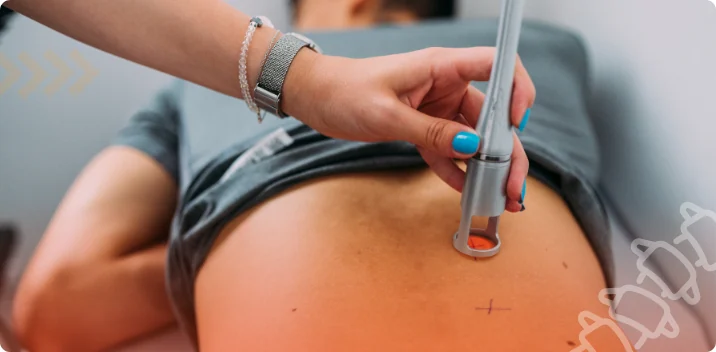
Cold laser therapy is one of the few treatments where the name works against it. Nothing is cold and nothing is cut. A handpiece rests on the skin over a sore area and delivers red and near-infrared light into the tissue underneath, and most people feel nothing while it happens. The reason it exists is the kind of pain that has stopped behaving. Something irritated a tendon or a joint eighteen months ago, the tissue never fully settled, the muscles around it learned to brace, and now rest makes no difference in either direction. You have probably tried the usual sequence by now: time off, ice, anti-inflammatories, a few weeks of feeling better followed by the same flare. Cold laser sessions delivered alongside hands-on care are aimed squarely at that stalled state, and they work by changing what is happening inside the cells rather than by pushing on the structure from outside.
What Is Cold Laser Therapy?
Cold laser therapy, known clinically as low-level laser therapy or photobiomodulation, uses specific wavelengths of red and near-infrared light delivered into tissue below the skin. The light is absorbed inside cells rather than converted to heat, which is why sessions are painless and leave no mark.
The leading explanation involves the mitochondria. A review of the proposed cellular mechanisms of photobiomodulation describes how cytochrome c oxidase, an enzyme in the mitochondrial respiratory chain, absorbs light in the red to infrared range, which appears to increase electron transport and raise production of the cell's energy currency. Reported downstream effects include reduced swelling, improved local circulation and better conditions for tissue repair.
The important word in that paragraph is proposed. The mechanism is well studied and still debated at the edges, and anyone describing it as settled science is overselling.
Why Does Some Pain Stop Responding to Rest?
Persistent pain is rarely one problem sitting still. Irritated tissue keeps the local inflammatory response switched on, the nervous system treats the area as something to protect, and the resulting muscle guarding restricts the very motion that would help the tissue recover.
That loop is why rest alone often stalls. Time off reduces the load and the symptoms quiet down, then the first normal week reintroduces the load to tissue that never actually finished repairing, and the cycle restarts from the same place. Each round tends to be a little more sensitive than the last.
Interrupting it usually takes more than one lever. Something has to change the tissue environment, something has to restore the motion that guarding removed, and something has to rebuild tolerance so normal activity stops being a provocation. Laser is a candidate for the first of those three.
What Does a Session Feel Like?
Undramatic. You sit or lie down, protective eyewear goes on, and the handpiece is held over the target area for a set time based on the depth and size of the tissue being treated. Most people feel nothing, some notice a faint warmth, and there is no recovery period afterwards.
Sessions are brief and usually stacked with whatever else the plan calls for, which is the point. A visit here might pair laser with an adjustment, soft tissue work, or the exercise guidance from your care blueprint, because one input rarely breaks a loop that took a year to build. You can see how laser therapy fits with the rest of the chiropractic care menu and where it stops being the right tool.
Results tend to build across a series rather than arriving in one visit. That is normal for this kind of treatment and it is also why a reassessment date matters more than a session count.
What varies between clinics is the dosing, and it is the part worth asking about. Wavelength determines how deep the light reaches, since near-infrared penetrates further than visible red, so a shoulder tendon and a plantar fascia are not treated with the same settings. Power and duration together set the total energy delivered, and both too little and too much appear to blunt the effect, which is the awkward part of this therapy and the reason protocols exist. Body composition over the treatment area matters as well, because tissue between the handpiece and the target absorbs some of what is delivered. None of that is something a patient should have to work out. It is something the clinician should be able to explain in a sentence when you ask why your settings are what they are.
Which Problems Is It Used For?
Laser is used most often where inflammation and slow tissue repair are central: tendon and muscle injuries, joint inflammation, plantar fasciitis, chronic neck and low back pain, and compression problems such as carpal tunnel syndrome.
MedlinePlus describes carpal tunnel syndrome as compression of the median nerve inside the wrist, producing numbness, tingling and weakness in the hand. The appeal of a light-based treatment in cases like that one is straightforward: it reaches tissue that is uncomfortable to press on and awkward to load, and it adds nothing to an already irritated structure.
It is also used as a supporting measure for peripheral neuropathy, where the realistic aim is easing symptoms, supporting circulation and improving day-to-day function. That framing matters. Nerve damage that is already established is not undone by light, and any clinic implying otherwise has told you something important about how they talk to patients.
What the Research Supports and What It Does Not
The strongest evidence is in specific conditions rather than across the board. A Lancet meta-analysis of low-level laser therapy for neck pain pooled sixteen randomised trials covering more than eight hundred patients and found significant reductions in pain intensity compared with placebo for both acute and chronic neck pain, with relief persisting for weeks after treatment ended and side effects no more frequent than in the placebo groups.
Two honest limits sit alongside that. Dose matters enormously, so wavelength, power and duration are not interchangeable between clinics, and a poorly dosed session is not a smaller version of a good one. The evidence base is also much stronger for some regions and tissues than others, which means a candid provider will tell you where your particular problem sits on that spectrum.
What none of the research supports is laser as a standalone answer to a complicated pain problem. Used as one input inside a plan that also addresses joint motion and loading, it earns its place.
Where Laser Fits in a Real Plan
Three ideas are worth carrying away. Cold laser therapy works through a photochemical effect inside cells rather than by heating tissue. Its evidence is real and condition-specific rather than universal. It performs best as one element of a plan that also restores motion and rebuilds tolerance.
If pain has outlasted rest, medication and time, the useful step is an exam that identifies what is still driving it rather than another month of waiting. Book an evaluation for low-level laser treatment for stubborn inflammation at the Lakeland or Lady Lake office and get a plan with a date attached to it. Dr. Justin Bergin, DC has spent 22 years combining hands-on care with supporting therapies under one roof, which is the part most patients have not had before. Chiropractic care here is billed through insurance and your benefits are verified in advance, and new patients can begin with a consultation, exam and report of findings for $47.
Frequently Asked Questions
Ready to take the next step?
Talk with the ChiroMed team about a cold laser therapy plan built around what your examination actually finds.